



The Many Faces of Our #AilleronExperts - Chapter 5
Meet Kuba, a Junior Software Developer at Ailleron. He is a young, ambitious man with clearly defined goals who is committed to growth and consistently expanding his career path. We invite you to read on—we hope this will motivate you to aim higher and reach your full potential. Under these conditions, long-term transformation plans based on fixed assumptions are becoming less safe and less efficient. Increasingly, value is created by actions that:
1. Hi, Kuba, thanks for agreeing to share your experiences and practical advice with us for beginner programmers.
Hi, I'm really glad to have this opportunity to give an interview and share my knowledge and experience. I hope this will help, even just a little, those who are just starting out on their programming journey.
2. Where did your passion for programming come from?
My true passion for programming didn’t emerge until I discovered “my” technology—one that really suited me. I had already tried coding in high school and later in college, but it didn’t interest me enough to build my future around it.
A lot changed when, during my student internship, I had to learn how to program for ERP systems and spent a little more time on it. I actually enjoyed it, but I felt that it wasn’t quite the kind of technology I wanted to work with, so I started looking for something more suited to me.
I’ve always enjoyed reading about the latest technologies, gadgets, and things like that. The idea popped into my head that it would be cool to create something myself—something I could use every day and that would be easily accessible. That’s when I realized I could achieve this by developing a mobile app for Android, so I decided to give it a try. I bought a course, and that’s when things really got started. Right from the start, I really liked this technology, and learning it was a lot of fun. Over time, I took more courses, created a few apps of my own, learned more advanced concepts, and I can confidently say that’s when my passion for programming was born.
3. Everyone’s career starts differently. Some people begin with an internship or apprenticeship. Others manage to find stable employment right after graduation. What were the early days of your career as a Junior Software Developer like?
I won’t deny that it was pretty tough. Whether I had graduated from high school or earned a degree in computer science didn’t really matter to recruiters. The experience I gained during my student internships was in a different technology, so when I switched to Android programming, many people initially ruled me out. They were primarily looking for candidates with commercial experience, which I didn’t have at the time.
Despite several months of searching and setbacks, I didn’t give up. I kept learning new things, expanding my portfolio, building apps, and sending my resume to more companies. Finally, someone from Ailleron reached out to me. First, I was given a recruitment assignment, which I did pretty well on and that led to a technical interview. It was that interview that ultimately decided whether I would be hired and given this opportunity, for which I am very grateful.
4. We’re so glad that Ailleron is where you can spread your wings! 😊 You work with the Android system every day. Where’s the best place to start learning if you want to become an Android developer? Webinars, training courses, books, or maybe industry articles?
I am not a fan of books when it comes to learning programming, especially in the context of Android, which develops very dynamically and is constantly changing. Books written even a few years ago may already be outdated, so it is sometimes not worth spending time learning the topics they describe. Today there are newer and better solutions.
While the basic principles of many programming languages remain unchanged and the knowledge you get from books may well be enough, I still find it a rather inconvenient way to learn how to code.
5. In this case, though, practice makes perfect, and gaining knowledge this way is the most effective approach.
I agree. Programming is best learned in practice, which is why I think it’s a very good idea to start with courses or industry articles that can teach you something while also giving you the chance to immediately try coding something yourself. While I was learning, I tried to write at least a very simple app after every course, which helped me consolidate what I had learned. Webinars and training sessions, on the other hand, are a good way to round out your knowledge once you already have the basics in a given field and know your way around it.
6. When a tricky task to solve comes up at work, where do you look for inspiration and reliable know-how?
Until recently, I used to look for similar problems and solutions on lots of programming forums. The main problem was that many of the threads were several years old and the solutions they suggested were already outdated, or the difficulties described differed from my own case. Other people’s tips simply didn’t work for me. I sometimes used YouTube videos as well, but that was fairly rare. Another source was technical documentation, although in many cases it left a lot to be desired, because the way it was written struck me as rather chaotic.
7. So there’s a “what did the author mean?” riddle to solve.
Exactly! On top of that, I increasingly turn to artificial intelligence for support. This field has developed enormously in recent years, and I don’t think there’s anything wrong with using tools like these if they are meant to make work smoother and faster. It may not yet be at a level where it can solve complicated tasks, but it certainly helps a great deal, and on top of that it is very easy to use. You just describe the problem and the AI suggests a few possible solutions. Even if they don’t work one hundred percent, they at least point you towards the right answer. Of course, I use it in line with company policy, so our code is safe. 😉
8. Do you have favorite bloggers, YouTubers, authors or industry gurus who inspire you and whose work you follow regularly?
Yes, at a certain point in my learning I came across a YouTuber called Philipp Lackner, who keeps up to date with knowledge and modern technologies related to Android development. I still follow him today. He records a huge number of videos. They are aimed mainly at beginner developers, but not only. In his materials he covers the fundamentals, presents modern solutions and technologies, as well as ways to improve performance or optimize apps — things even more experienced developers can learn a lot from. I think he explains things in a really simple and understandable way, which allowed me to get to grips with many complex topics. Since I found his channel, I have noticed huge progress in the way I write code and build apps. I think Philipp’s profile is worth following, if only for his recurring videos in which he gathers and presents the most important Android and Kotlin news of each month.
9. Professional growth depends to a large extent on where we work. How does Ailleron support you in this?
Ailleron offers plenty of opportunities when it comes to development. Besides the main project I work on every day, I have also had the chance to work on other initiatives, and I learned a lot from them. I took part in adapting our company product, LiveBank, so that it meets WCAG requirements — that is, accessibility for people with disabilities. That project taught me a great deal about accessibility, and it is practical knowledge that may prove very useful in the near future. Under the new guidelines, other applications will also have to be adapted to the needs of people with disabilities.
On top of that, we get to work with new technologies. Recently we delivered a project in KMP (Kotlin Multiplatform) that involved building a cross-platform library for advertising banners. The technology we used made it possible to write shared code for both Android and iOS. There is a good chance that cross-platform development will grow in importance in the mobile industry over the next few years, so the knowledge we gained may turn out to be very valuable.
Guilds are a popular initiative that lets people grow professionally. Ailleron has quite a few of them, and the one I take part in is the Mobile Guild, which brings together developers from across the company who work with mobile technologies. We meet every two weeks to share experiences, knowledge, problems and solutions from our projects, and to get familiar with new technologies and design patterns.
Every employee also has a pool of 80 development hours that they can spend on all kinds of courses and training.
10. To sum up, what three pieces of advice would you give to people who are starting their career as a Software Developer?
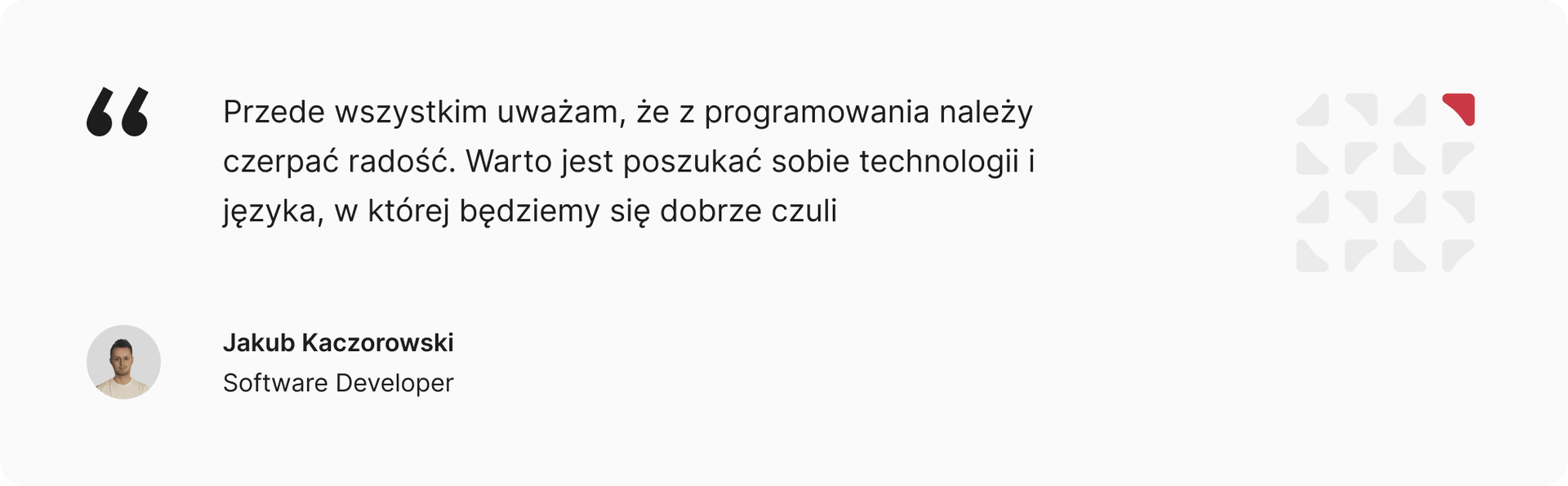
First and foremost, I believe you should take joy in programming. If you are learning to code only to change careers for better pay, that is probably not the way to go. You can collide with reality quickly and quite brutally that way, so right at the start it is worth asking yourself whether this is really what you want to do. If the answer is yes and you intend to head in that direction, then in my opinion it is worth looking for a language you feel comfortable with. There are a great many options, and it is better to develop in a technology that genuinely interests you than in the one that is most in demand or offers the highest pay, because otherwise it is easy to burn out.
11. The passion we are talking about is undoubtedly a source of motivation to act and to grow. What do you think is equally important?
That is exactly what I think. My next piece of advice is that you need to stand out from the competition when looking for a job. There are often dozens, and sometimes even hundreds, of people applying for a single position. You have to show right from the start why they should bet on you. Preparing a good CV that immediately catches recruiters’ attention and draws them in is very important here. A suitable portfolio matters just as much.
If we do not have experience, we have to prove that we can code, and the best way to do that is to share our own projects in a repository. It is good, though, for these to be well-thought-out apps that genuinely show what we can do. In many groups I have come across situations where people presented projects that were 95% based on the app from a course. The only change was a different color palette or minor visual tweaks. Unfortunately, that approach will not get you very far, because it does not prove in any way that you understand the topics from the course and can put them to use. It would be better to plan out a few apps — even simple ones — that do not have to be innovative, but that show you have a solid grasp of many aspects of a given technology.
The last piece of advice may sound a little clichéd, but it is very true — in my opinion you must not give up, especially if you are just starting your career and do not have much experience. The IT market has not been very forgiving lately and the entry barrier is quite high, so you have to arm yourself with patience and accept that finding your first job may take a while. Early in your career it is rare for companies to reach out to you, so it is up to you to actively look for opportunities. Focus on development and learning new things, but do not forget about building soft skills either, because the IT industry is not only about technical knowledge.
Kuba, thank you very much for this conversation. I think it will be a huge dose of motivation, especially for people who are just starting their adventure with IT and trying to find their bearings in this environment. I wish you every success!
Thank you for the conversation!